How to Start a Web Hosting Business in India (Reseller Hosting Guide 2026)
Learn how to start your own web hosting business in India with reseller hosting. Discover startup costs, WHMCS automation, pricing strategies, customer acquisition and ways to grow your hosting company.
Zonetic Hosting Team
Blogger & SEO Expert
In this article
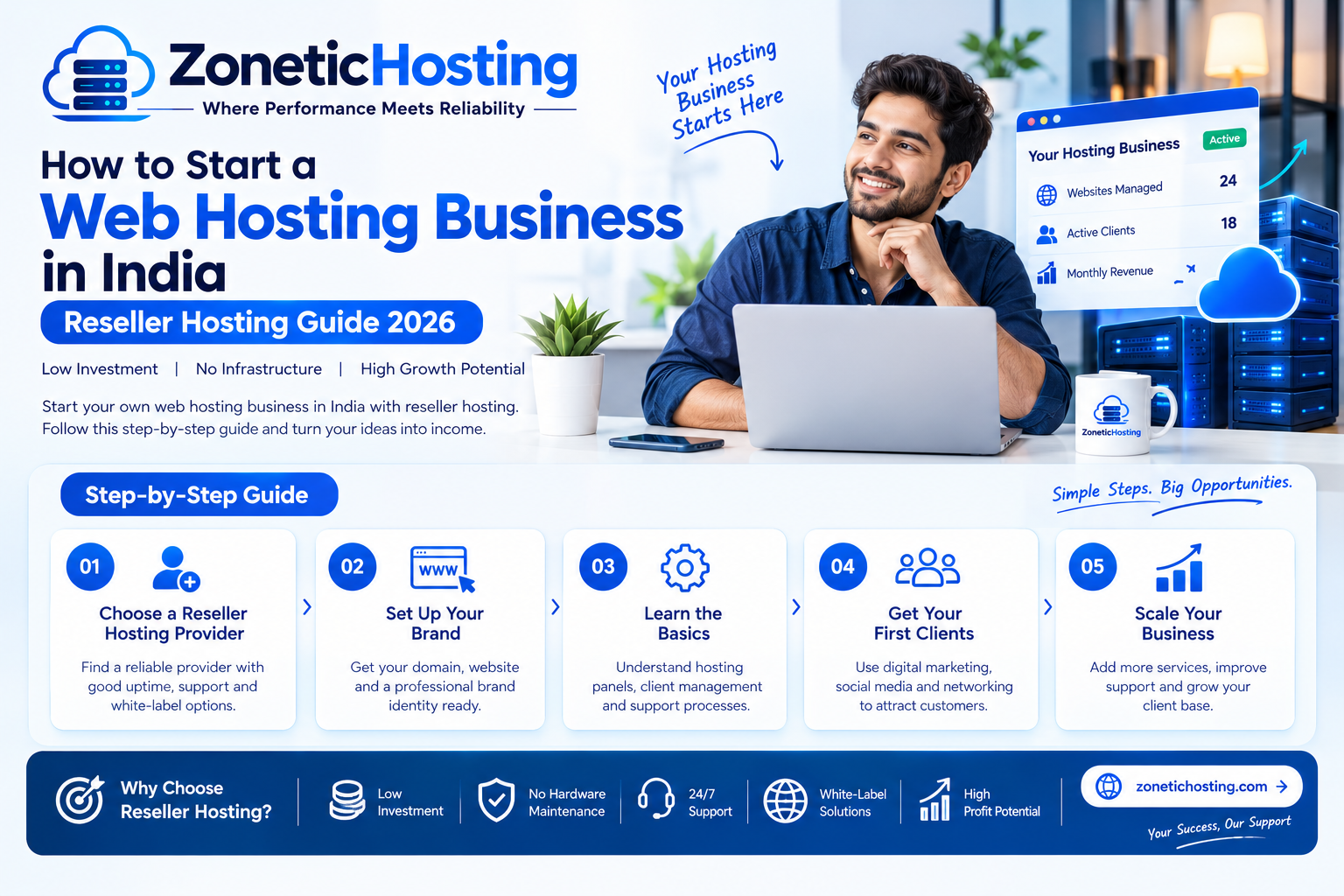
Starting a web hosting business in India in 2026 can be an interesting business opportunity for entrepreneurs, freelancers, developers, and digital agencies. As more businesses move online, the demand for websites, domains, business email services, and reliable web hosting continues to create opportunities for hosting providers.
The good news is that you do not need to build your own data centre or purchase expensive physical servers to start a hosting company. You can begin with a reseller hosting account, build your own hosting brand, sell hosting packages, and manage customers through automated billing software.
In this guide, we will explain how to start a web hosting business in India, how reseller hosting works, what investment you may need, how to set your hosting prices, and how to get your first customers.
1. What Is a Web Hosting Business?
A web hosting business provides server space and related services that allow individuals and businesses to make their websites accessible on the internet.
As a hosting provider, you can sell different services, including:
- Shared web hosting
- Linux reseller hosting
- WordPress hosting
- VPS hosting
- Business email hosting
- Domain registration
- SSL certificates
- Website migration services
You can start by offering only shared hosting and gradually introduce additional services as your customer base grows.
2. What Is Reseller Hosting and How Does It Work?
Reseller hosting is one of the easiest ways to enter the web hosting industry without managing your own physical server infrastructure.
In a reseller hosting model, you purchase hosting resources from an established hosting provider and distribute those resources among your own customers.
You can create your own hosting packages, decide your selling prices, manage customer accounts, and promote your business under your own brand, depending on the reseller provider's white-label capabilities.
For example, suppose you purchase a reseller hosting package that provides 100 GB of storage. You can divide that storage into multiple hosting accounts and sell them to your customers according to your package limits.
The hosting provider manages the underlying server infrastructure, while you focus on customer acquisition, billing, support, and business growth.
How the reseller hosting business model works
- Purchase a reseller hosting package from a hosting provider.
- Create your own hosting packages.
- Set prices for your customers.
- Build a website for your hosting brand.
- Accept orders and payments.
- Create and manage customer hosting accounts.
- Provide technical support and renewals.
This model allows you to start a hosting business without the cost and complexity of owning a complete server infrastructure.
3. Choose the Right Hosting Business Model
Before starting your business, understand the different ways to operate a hosting company.
Reseller Hosting
Reseller hosting is generally the simplest starting point. You purchase a reseller package and sell smaller hosting packages to your customers.
Advantages:
- Lower initial investment
- No need to purchase physical servers
- Less server administration
- Easy to start with a small customer base
- Potential for white-label branding
VPS-Based Hosting Business
Another option is to rent a Virtual Private Server and install suitable hosting management software.
With this approach, you have more control over server resources, configurations, and customer accounts. However, you are also responsible for server security, updates, monitoring, backups, and troubleshooting.
This model is more suitable for developers and people with Linux server administration experience.
Dedicated Server Hosting
Dedicated server hosting involves renting or owning an entire physical server. It offers greater control and resources but usually requires a higher investment and more technical knowledge.
For a new hosting company, starting with reseller hosting is generally more practical than immediately investing in dedicated infrastructure.
4. Choose a Good Reseller Hosting Provider
Your upstream hosting provider plays an important role in your business. Server performance, uptime, support, security, and available resources directly affect the experience of your customers.
Before purchasing reseller hosting, compare the following features:
- Storage: Check the total disk space included in the package.
- Bandwidth: Understand the data transfer limits and usage policies.
- Control panel: Check whether WHM, cPanel, or another management panel is provided.
- White-label support: Check whether you can use your own company branding and nameservers.
- Account limits: Understand how many customer accounts you can create.
- Backups: Check backup frequency, retention, and restoration options.
- Server security: Look for malware protection, isolation, and security updates.
- Technical support: Choose a provider with reliable support availability.
- Upgrade options: Make sure you can upgrade when your business grows.
Do not select a reseller provider based only on the lowest advertised price. Poor server performance or unreliable support can result in customer complaints and cancellations.
5. Create Your Hosting Business Brand
Your brand is what customers will recognize when purchasing hosting services from your company.
Choose a professional business name that is easy to remember and suitable for the hosting industry.
You should arrange the following before launching:
- A professional business domain name
- A company logo and brand identity
- A professional website
- Hosting pricing and package pages
- Contact information
- Terms of Service
- Privacy Policy
- Refund and Cancellation Policy
- Acceptable Use Policy
Your website should clearly explain your hosting features, pricing, billing cycles, support availability, and service conditions.
Customers should be able to understand what they are purchasing before completing an order.
6. Set Up a Website and Hosting Packages
A professional website is essential for a hosting business because most customers will compare your packages, features, and prices before placing an order.
Your website should include the following important pages:
- Home
- Web Hosting
- Reseller Hosting
- VPS Hosting
- Domain Registration
- About Us
- Contact Us
- Knowledge Base
- Terms and Conditions
Start with two or three simple hosting packages instead of creating too many options.
For example:
| Package | Suitable For | Example Resources |
|---|---|---|
| Starter | Personal websites | 1 website, 10 GB storage |
| Advance | Small businesses | Multiple websites, 25 GB storage |
| Business | Growing businesses | Higher storage and website limits |
These are illustrative package structures. Set actual limits according to your purchased server resources and hosting provider's policies.
Make your pricing transparent. Clearly mention whether prices are monthly equivalents, annual payments, or long-term promotional rates.
7. Use WHMCS to Automate Your Hosting Business
Managing hosting customers manually can become difficult as your business grows. This is where WHMCS can help.
WHMCS is a billing and automation platform designed for hosting businesses. It helps manage customers, orders, invoices, payments, support tickets, and hosting services from a central dashboard.
Some useful WHMCS features include:
- Automated customer registration
- Hosting order management
- Automatic invoice generation
- Payment gateway integration
- Automated account provisioning
- Service suspension and termination automation
- Domain registration integration
- Support ticket management
- Customer billing portal
- Affiliate and referral management
For example, when a customer purchases a hosting package and completes payment, WHMCS can automatically create the hosting account if the relevant server module is configured correctly.
Similarly, recurring invoices and renewal reminders can reduce manual work.
WHMCS is not mandatory for starting a hosting business, but it can make customer and billing management significantly easier as your business grows.
8. Set Up Payment Methods and Billing
Customers should be able to purchase hosting services through convenient and trusted payment methods.
For an Indian hosting business, consider integrating suitable payment options such as:
- UPI payments
- Credit and debit cards
- Net banking
- Supported payment gateways
- International payment options where available
Make sure your payment gateway supports your business category and settlement requirements.
Configure automated invoices, payment confirmations, renewal reminders, and overdue payment notifications.
If you operate in India, understand your applicable business registration, taxation, invoicing, and GST obligations. Consult a qualified accountant or tax professional to determine the requirements for your business.
9. Calculate Your Hosting Business Investment
The investment required to start a hosting business depends on your business model, hosting resources, software licenses, website development, and marketing budget.
A reseller-based business generally requires less initial investment than operating your own VPS or dedicated server infrastructure.
Here are some expenses you may need to consider:
| Expense | What It Covers |
|---|---|
| Reseller hosting | Hosting resources purchased from your provider |
| Domain name | Your company's website address |
| Business website | Website design and development |
| Billing software | WHMCS or another billing solution |
| Payment gateway | Payment processing charges |
| Marketing | Advertising, SEO, and promotions |
| Support | Customer support and operational expenses |
Some providers may include control panels, billing software, SSL certificates, or other services in their reseller packages. Check what is included before calculating your actual investment.
Start with the essential services you need. Avoid purchasing expensive infrastructure and software licenses before you have enough customers to justify the additional costs.
10. How to Price Your Hosting Plans and Make Profit
Pricing is one of the most important parts of running a hosting business.
Your selling price should cover your hosting costs, software licenses, payment processing fees, support expenses, marketing costs, taxes where applicable, and desired profit margin.
For example, consider this simplified business calculation:
| Business Metric | Example Amount |
|---|---|
| Monthly operating costs | ₹3,000 |
| Number of active customers | 50 |
| Average monthly revenue per customer | ₹100 |
| Total monthly revenue | ₹5,000 |
| Estimated operating surplus | ₹2,000 |
This is an illustrative calculation before applicable taxes and any unlisted expenses. Actual profit depends on customer usage, billing periods, renewals, cancellations, and operating costs.
Consider offering monthly, annual, and multi-year billing options. Longer billing cycles can improve cash flow, while monthly options may make your services accessible to customers who prefer smaller payments.
Avoid competing only on price. Reliable support, transparent policies, good performance, and useful features can help your business stand out.
11. How to Get Your First Web Hosting Customers
Finding customers is one of the biggest challenges when starting a hosting business.
Instead of targeting everyone, start with a specific audience that needs website hosting.
Target Freelancers and Web Developers
Freelancers and website developers regularly build websites for clients. They may need hosting services for their own projects or their customers' websites.
Build relationships with developers and offer hosting packages that are suitable for their projects.
Use SEO and Content Marketing
SEO can help your hosting business attract customers who are already searching for hosting services.
Create useful articles targeting search terms such as:
- Best web hosting in India
- Affordable web hosting for small businesses
- How to start a website in India
- Shared hosting vs VPS hosting
- Best hosting for WordPress websites
- How to choose a reseller hosting provider
Publish informative content regularly and link relevant articles to your hosting product pages.
Run Targeted Advertising Campaigns
You can use Google Ads and social media advertising to reach people interested in website development, online businesses, and hosting services.
Focus on relevant audiences and measure meaningful results such as enquiries, completed registrations, and paid orders rather than clicks alone.
Use WhatsApp for Customer Communication
WhatsApp can be useful for answering pre-sales questions, explaining hosting packages, and following up with potential customers.
Provide clear information about pricing, billing periods, features, and support before asking customers to place an order.
Build Referral Opportunities
Existing customers and website developers can recommend your hosting services to others.
You can introduce a referral or affiliate program with clearly defined commission rules, payment conditions, and tracking.
12. Provide Good Customer Support
Customer support is essential in the hosting industry. Customers may contact you when their websites stop working, SSL certificates expire, email accounts fail, or they experience database errors.
Establish clear support procedures from the beginning.
Important support practices include:
- Define support working hours.
- Provide a support ticket system.
- Maintain a useful knowledge base.
- Document common troubleshooting procedures.
- Monitor server availability.
- Communicate planned maintenance.
- Keep customers informed about service incidents.
Do not promise 24/7 support unless you can consistently provide it.
Good customer support can improve customer satisfaction, encourage renewals, and generate referrals.
13. Common Mistakes to Avoid When Starting a Hosting Company
Many new hosting businesses struggle because they focus only on selling hosting packages without planning their operations.
Avoid these common mistakes:
- Choosing an unreliable provider: Poor server performance can damage your reputation.
- Underpricing your services: Prices that do not cover operating costs can make the business unsustainable.
- Ignoring renewals: Recurring billing and renewal reminders are important for predictable revenue.
- Not maintaining backups: Understand your provider's backup policies and maintain an appropriate recovery strategy.
- Overpromising resources: Do not sell more resources than your infrastructure can reasonably support.
- Ignoring security: Keep software updated and establish account security procedures.
- Neglecting customer support: Slow responses can lead to cancellations and negative reviews.
- Spending too much on advertising: Test small campaigns and measure actual paying customers before increasing your budget.
14. How to Scale Your Web Hosting Business
Once you have established a stable customer base, you can gradually expand your services.
Some opportunities for growth include:
- Introducing higher-resource shared hosting plans
- Offering Linux reseller hosting
- Adding KVM VPS hosting
- Providing domain registration
- Offering SSL certificates
- Creating hosting packages for web developers
- Introducing website development services
- Building referral partnerships
Monitor your server resource usage, customer retention, recurring revenue, and support workload before expanding.
Upgrade your infrastructure when your customer demand and resource requirements justify the investment.
Conclusion: Is Starting a Web Hosting Business in India Worth It?
Starting a web hosting business in India in 2026 can be a practical opportunity for entrepreneurs, freelancers, and developers who want to build a recurring-revenue business.
You do not need to begin with expensive servers or a large infrastructure investment. Reseller hosting allows you to start with a smaller setup, create your own hosting packages, and focus on building a customer base.
The most important factors are choosing a reliable hosting provider, setting sustainable prices, automating billing, providing dependable customer support, and consistently acquiring new customers.
Start small, understand your customers' requirements, and expand your services as your business grows.
Frequently Asked Questions (FAQs)
1. How can I start a web hosting business in India?
You can start by purchasing a reseller hosting package, registering a business domain, creating a hosting website, setting up billing software, configuring payment methods, and marketing your hosting packages to potential customers.
2. Is reseller hosting profitable in India?
Reseller hosting can be profitable when your customer revenue exceeds hosting, software, marketing, payment processing, and support expenses. Profitability depends on pricing, customer retention, and operating efficiency.
3. How much investment is required to start a hosting business?
The initial investment depends on your reseller package, domain, website, billing software, payment gateway, and marketing budget. A reseller-based model generally requires less infrastructure investment than operating your own servers.
4. Do I need my own server to start a hosting company?
No. You can start with reseller hosting from an established hosting provider. You can consider VPS or dedicated server infrastructure later as your business grows.
5. What is the best software for managing a hosting business?
WHMCS is a popular hosting billing and automation platform. It supports customer management, invoices, payments, service provisioning, support tickets, and domain integrations.
6. Can I start a hosting business without technical knowledge?
You can start with reseller hosting without advanced server administration knowledge. However, understanding DNS, domains, SSL, hosting control panels, email, and basic website troubleshooting will be helpful.
7. Can I sell hosting under my own brand?
Yes, many reseller hosting providers support white-label services. Check whether your selected package allows custom branding, private nameservers, and branded customer interfaces.
8. How do hosting companies earn money?
Hosting companies earn revenue by selling hosting plans, domain registrations, VPS services, SSL certificates, email services, and other website-related products. Their profit depends on operating costs and customer retention.
9. Is WHMCS necessary for a hosting business?
WHMCS is not compulsory, but it can automate billing, customer management, invoices, payment processing, and hosting account provisioning. It becomes especially useful as the number of customers increases.
10. How can I get customers for my hosting business?
You can attract customers through SEO, Google Ads, social media advertising, partnerships with web developers, referrals, and useful educational content about domains and web hosting.
11. Can I upgrade from reseller hosting to VPS hosting?
Yes. As your customer base and resource requirements increase, you can move to VPS-based infrastructure or other hosting solutions. Plan the migration carefully to minimize downtime.
12. What is the most important factor in running a successful hosting business?
Reliable infrastructure, transparent pricing, good customer support, effective billing automation, and customer retention are all important factors in building a sustainable hosting business.
Have a question about hosting?
Our team can help you pick the right plan for your website.